 Cop's Eye View Of Domestic Violence And The Military — Memorial Day
Cop's Eye View Of Domestic Violence And The Military — Memorial Day
Cop's Eye View Of Domestic Violence And The Military — Memorial Day| EJF Home | Find Help | Help the EJF | Comments? | Get EJF newsletter | Newsletters |
| Domestic Violence Book | DV Site Map | Data tables | DV bibliography | DV index |
| Chapter 3 — The Impact Of Domestic Violence Laws On Veterans And National Security |
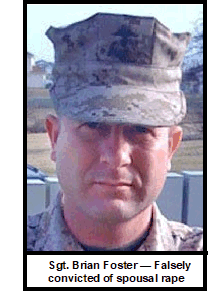
| Next — Camp Pendleton Marine Free After False Spousal-Rape Conviction Tossed Out |
| Back — Another Victim Of The Homeland Security State by William Grigg |
May 28, 2007 — Two of my friends had been dispatched to a domestic disturbance. That's pretty normal, and about 90% of the time people call the police on their spouse because they're mad at each other. I'd say we make an arrest about 10% of the time (we are required to arrest if probable cause exists, but yelling isn't probable cause).
So, no big deal, I thought. They'll show up, talk to both sides, and tell them to behave like adults before they leave. The caller was the female half, and she reported that her neck was injured.
“OK,” I thought, “maybe there really is something to this one. We'll see.” About half the time someone reports an injury, they're lying to get us there faster, you see.
Anyway, it wasn't my concern. Two other cops had been dispatched. So I parked myself at one of our top 25 accident intersections to “monitor traffic.” We have to do that so many times per trimester, you see, so I had to check the box. I had the radar plugged in and would have pulled someone over for going really fast, but I was actually there to eat lunch.
Brand new hot cup of coffee with hazelnut creamer in hand, I opened up my lunch. It had been a long, busy work day thus far, and I was really looking forward to it.
No sooner did I get it open when the officers on the domestic call called for “cover code 3." As restrictive as our policy is on running with lights and sirens, I knew it was bad in a big way.
Sure enough, the dispatcher called my call sign to respond. Having learned from past experiences I tossed the piping hot coffee right out the window and took off like Richard Petty. Lights and sirens blaring, I was doing over 110 mph down ______ Blvd. It was about 0400, so there was scant little traffic to maneuver around (of course I passed three DUI drivers and could do nothing about it).
While I was still en route, I heard the officers radio that they were fighting with one suspect (the domestic suspect's friend), and had Tased him. They also aired that the primary suspect had barricaded himself inside the house and could be seen putting on body armor.
Oh crap. No one puts on body armor unless they're getting ready for a real fight. I'm thinking “Branch Davidian” stuff. I mashed the pedal even harder. I really don't know how fast I was going at that point, because I was too busy driving to look down at the speedometer. You drive by the seat of your pants (literally — trained drivers know what I mean — you feel what the car is doing in your butt) when you're going that fast.
I rolled up and cut the sirens off, grabbed Ol' Bessy, my 12 gauge shotgun, out of the rack, and ran. I could see one officer fighting with a suspect (the Taser hadn't worked), and the other officer had his pistol trained on the house. I knew immediately that the second officer wasn't helping to fight the suspect because there was a threat in the house — the barricaded suspect — he had to watch their backs.
So I ran up on the officer that was fighting and butt stroked the suspect in the head with my shotgun. That got his attention, and the handcuffs were on in a matter of seconds. The officer then dragged that suspect away, threw him in the back of a cruiser, and moved the cruiser a few houses down. Where it had been parked the suspect in the cruiser would have been directly in the line of fire had we started shooting it out with the barricaded suspect.
OK, one suspect was secure. We started setting up containment around the house so the suspect inside couldn't get away. I caught a glimpse of him through a window, and realized that the body armor he put on wasn't the “normal” stuff we wear. It was the IBAS “Interceptor” armor currently being used by the military, and it has tough ceramic plates over an inch thick in addition to the Kevlar shell. I've actually seen people get shot by an AK-47 when they're wearing this stuff and bounce up shooting, uninjured. [The cop is an Army veteran]
Oh crap. Images of the Los Angeles bank robbery from about ten years ago started going through my head. As my shotgun was loaded with buckshot, I figured I'd better up the ante and cranked some slugs into it. A slug to the body wouldn't stop a guy with that armor on, but it would knock him down and allow us some groin and head shots (the idea in a groin shot is to destroy the pelvis so they can't advance on you — it's not about blowing away his privates, although if it happens then too bad for him).
Containment was established quickly, and we learned that the female victim was with another officer nearby. She related that no one else was in the house. Good. The only person to worry about was the bad guy. We didn't have to worry about hostages or kids getting caught in the line of fire. More good news.
We knew he was still inside because he quickly set about pushing the furniture up against the doors. He started yelling through the walls that we were going to have to kill him, too. A police sergeant showed up and took command. The garage door was open, and the suspect was standing near the door leading into the house. We could hear him, and he was shouting at us through the door. There was also a pick-up parked in the garage. I snuck into the garage and used the pick-up for cover. I was about 10 feet from the door and off to the side so that he wouldn't see me if he opened it.
After a few minutes, he opened that door and the police sergeant tried to negotiate his surrender. The guy would talk for a few minutes, but the only things he would say was that we were going to have to kill him, he was going to kill himself, etc. He even challenged us to come inside after him a few times, but he refused to show us both hands at once. We assumed he was armed. He also had a large Rambo-type knife strapped to his hip.
After a few minutes of talking, he'd get angry and slam the door. The police sergeant paged the SWAT team. Then the suspect returned to the door and we repeated the first session — threats, challenges, etc., followed by slamming the door. This went on for about an hour and a half. Of course the SWAT team never got there.
When the suspect was inside once, I got the opportunity to look at some of the items in the garage. He had Army duffle bags with his unit, rank, and other information painted on the bottom. From that, I learned that he was a Staff Sergeant in the infantry. I also recognized the unit, and knew that they had just returned home from their second deployment to Iraq.
“Great,” I thought. “The Army used him up, made him go nuts, and now I'm going to have to kill him.” We're seeing more and more of that as the war drags on.
Once, the suspect opened the door and the negotiations resumed. I couldn't see him from where he was standing, but I could tell by the changes in his voice that he was planning a bold move. Then he did a “combat peak” — he checked the corner around which I was hiding very quickly, and without exposing hardly any of himself to my fire (my shotgun was aimed at the drywall next to the door. From the angle, I knew that my slug would go through the drywall and tag him). No one knows how to do that unless they're combat trained. It confirmed what I had learned from his duffle bags — this guy was no chump looking to fight the cops, he was an experienced war veteran who knew how to handle such things. It confirmed in my mind that I was going to have to shoot this guy — he wasn't surrendering, and he had just seen where I was located. Oh crap.
Oh yeah, as to tasing him, no way. That armor won't conduct the electricity. OC [pepper] spray? Too far away. Charge? Heck no, we were still assuming he was armed. Crap. Crap. Crap. The negotiations continued, and the SWAT team was still getting out of bed.
Finally after about an hour and a half, the suspect said, “Guys, I'm starting to sober up.” That was our break. A few more minutes of talking and the guy took the body armor off, and walked out to surrender.
“One in custody.” Gee, thanks a lot SWAT team! Glad you could show up!
Official statistics suggest there is at least a 1 in 5 chance the SSgt. in this incident had suffered a brain injury as a result of his service in Iraq. Closed-head injuries are known to cause violent behavior by those who have suffered such trauma.
Post traumatic stress disorder (PTSD) is a given in this case. Putting on battle armor suggests this incident may have been an alcohol-fueled “flashback.” The government, having created this, will now use the legal system to make the SSgt's problems infinitely worse.
This is not “domestic violence” in the classical sense of battering and power and control. Without doubt this is a mental health problem and today we have reinstituted the barbaric practice of using jails to contain the mentally ill. Locally 15-17% of the prisoners in our jail have moderate to severe mental health problems.
The SSgt. will certainly be discharged from the Army as a result of this incident, probably with a bad conduct discharge. As a result he will lose all his Veterans Administration benefits and health care, and virtually all his civil liberties for life. A fine way to repay this man's service to his country.
What was the role of the woman in this incident? Generally it takes two to tangle. Apparently she was injured in the throat area and had petechial hemorrhaging in the eyes, which is only caused by strangulation. Strangling in these cases is often associated with jealousy. Did the SSgt. come back from Iraq to find his wife or girlfriend was having an affair? Quite a common occurrence today. Although we can only speculate as to the cause in this incident, jealousy is a dangerous emotion, especially when mental illness is a factor.
This is hardly an isolated incident and they are growing in frequency as the wars in Iraq and Afghanistan drag on, which the officer notes.
SWAT teams are very expensive to equip and train and had a SWAT team been present they may have aggravated the situation with this combat veteran as in the case with Jaime Dean. In many quarters the concept of local police maintaining paramilitary units like SWAT teams is under heavy criticism for a variety of reasons. Columbine comes to mind. Certainly the incident described above calls into question the value and effectiveness of such a paramilitary unit.
Clearly the officers on the scene acted in a professional manner and are to be commended for their restraint in this sad incident.
Society is ill-prepared for incidents such as this one, especially with domestic violence laws based on a deeply-flawed ideology.
Our military forces are desperately trying to treat returning soldiers and Marines for the mental health problems and physical injuries generated by multiple tours in ill-defined theaters of war. But more and more of these veterans are returning to civilian life and ruin where the only mental health help available to them may be in jail.
Problems with PTSD and closed-head injuries often do not occur until months or years later and treating these as “domestic violence” with the Duluth model is the acme of idiocy. We must find better ways of dealing with these problems without destroying the lives and families of these veterans. Current DV dogma is only exacerbating the issues. The officer who wrote about the above incident was particularly emphatic about the need to remove the mandatory arrest provision in current laws and giving line officers more discretion.
On this Memorial Day we may all want to pause and reflect on how we should treat our veterans, now, and in the future.
| EJF Home | Find Help | Help the EJF | Comments? | Get EJF newsletter | Newsletters |
| Domestic Violence Book | DV Site Map | Data tables | DV bibliography | DV index |
| Chapter 3 — The Impact Of Domestic Violence Laws On Veterans And National Security |
| Next — Camp Pendleton Marine Free After False Spousal-Rape Conviction Tossed Out |
| Back — Another Victim Of The Homeland Security State by William Grigg |
This site is supported and maintained by the Equal Justice Foundation.